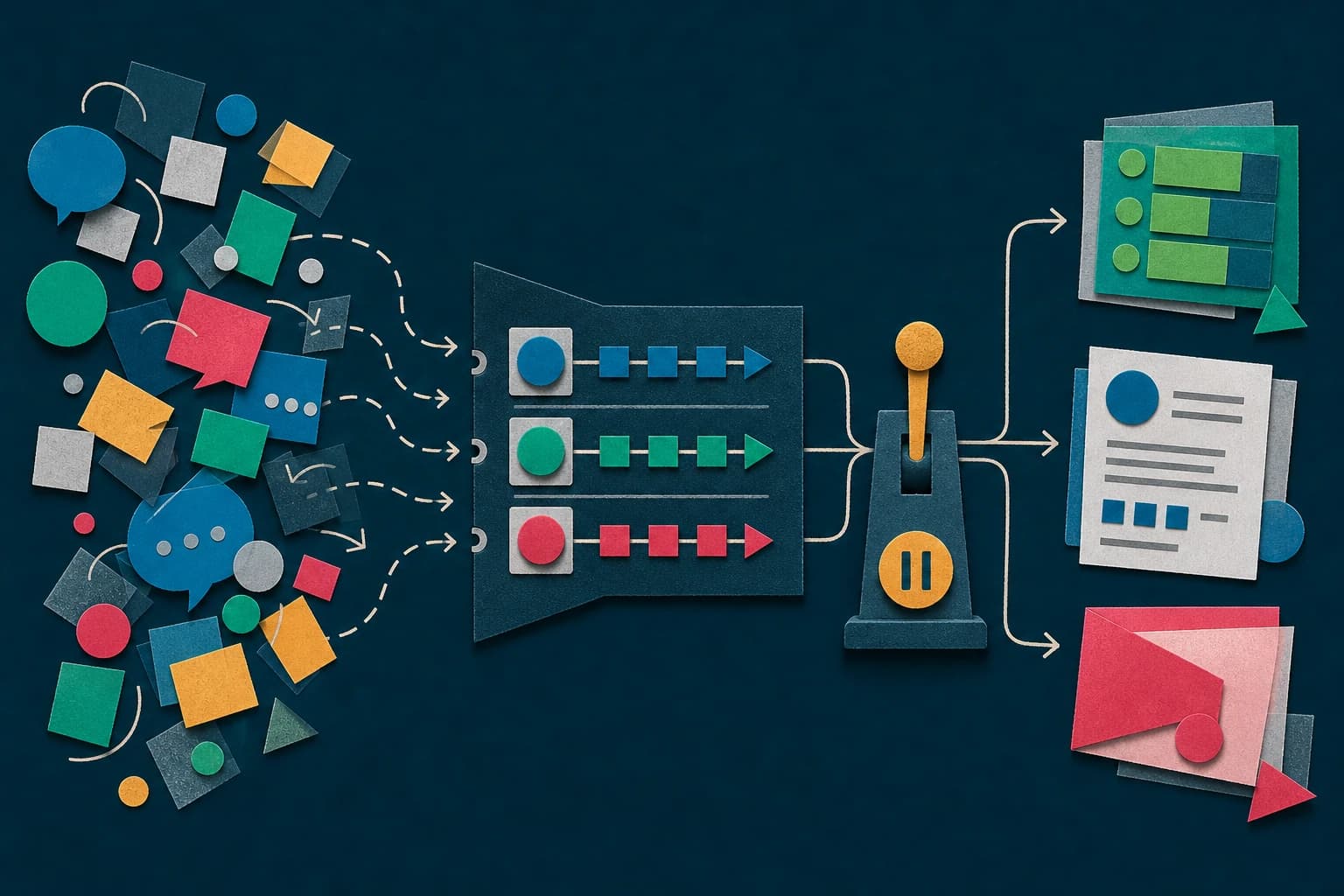
Meeting notes are not an operating system
Meetings end and the signal scatters across heads, notes apps, chat threads, and AI summaries. The work is technically captured, but nobody can tell which idea became a commitment, whether it duplicates existing work, who has capacity, or what decision is still missing.
Extracting task-like sentences is the easy part. The difficult part is turning conversation into appropriately scoped work without letting an AI quietly make organizational decisions.
A hybrid debrief, not one large prompt
The debrief combines language-model judgment, deterministic validation, and a human approval boundary:
- Resolve the transcript and meeting context.
- Load relevant goals, team roles, and existing tasks.
- Extract decisions, commitments, open questions, and possible work with source evidence.
- Run the scope cutter: prerequisites, capacity, sequencing, and formalization.
- Validate required fields and exact duplicates.
- Render an interactive review packet.
- Let the operator create, link, skip, edit, reassign, or defer each proposal.
- Dry-run the approved changes, write them, and read them back for verification.
The model handles ambiguity in the conversation. Code handles schema, exact matching, arithmetic, reply parsing, and write verification. The operator retains the decisions that require context and authority.
See the review packet
This is a condensed, anonymized reconstruction of the HTML packet the workflow actually produces. The project details are fictional, but the structure is real: proposed work, source evidence, dependencies, capacity warnings, duplicate matches, missing decisions, and explicit Create, Link, or Skip controls.
Change an action in the packet to see the reply update. Then open How it works for the technical view of the pipeline.
The packet is a review surface, not a task generator with a nicer interface. A proposed task remains a proposal until the operator acts on it.
Detailed enough to delegate
Turning a transcript into a task title is easy. The title is also the least useful part of the task.
Someone still has to recover why the work exists, what outcome the team meant, which constraints were agreed to, what must happen first, and how everyone will know it is done. That reconstruction is incredibly valuable because it prevents ambiguity and rework. It is also work no human should spend their time doing by hand after every meeting.
The debrief turns the meeting evidence into a detailed execution brief:
- the outcome and why it matters;
- the context someone needs before starting;
- the expected deliverable;
- constraints, decisions, and dependencies;
- one owner and any contributors;
- clear done-when criteria;
- the source evidence behind the task.
That level of detail makes the work portable. A person can take ownership without attending the original meeting or chasing the organizer for context. An AI agent can work from explicit instructions and acceptance criteria instead of guessing what a five-word task title was supposed to mean.
The system is not deciding what people should do. It is removing the repetitive translation work between a decision and a delegation-ready task, while keeping the actual decisions with the operator.
The scope cutter is where the judgment lives
Prerequisite check
Before work is scheduled, the system asks what must be true first. A task that depends on an unnamed approver or an unresolved policy decision is flagged rather than presented as ready.
Capacity gate
The model can suggest an owner and size. Deterministic arithmetic compares the proposal with current load. When the assignment would overload someone, the packet surfaces the conflict and invites reassignment or deferral.
Sequencing reframe
When two priorities compete, the system can propose a sequence instead of pretending both fit at once: first establish the dependency, then begin the larger build after the handoff condition is met.
Formalization
Loose language becomes a reviewable task with one lead, a bounded outcome, size, timing, dependencies, and a trace back to the meeting evidence.
Evidence artifact
AI proposes. The operator disposes.
The write path stays closed until review, validation, and a dry run succeed.
| AI judgment | Deterministic rails | Human authority |
|---|---|---|
| Read commitments and ambiguity | Enforce required fields | Approve or reject the work |
| Suggest scope and sequencing | Check exact duplicates | Change owner, size, and timing |
| Surface missing decisions | Calculate capacity | Decide what becomes official |
| Explain why a proposal exists | Dry-run, write, and read back | Resolve organizational nuance |
Failure behavior is part of the design
The workflow does not hide degraded context. If existing tasks cannot be loaded, the reviewer sees a warning rather than a false promise that duplicate checking succeeded. Invalid proposals cannot be committed. Skipped work is recorded instead of disappearing. Every accepted task retains its meeting evidence and the reviewer's changes.
The result is not merely faster note cleanup. It is a dependable boundary between conversation and operational truth: automation handles the repeatable work, and people remain responsible for the decisions that affect other people's time.